Central banks are still turning to gold, and the move is not just about price momentum.
In a Money Metals News Service analysis, Mike Maharrey argues that official-sector gold buying has helped support the metal’s bull market even as expectations for higher interest rates created headwinds. He points to four forces behind the trend: geopolitical risk, concern over the dollar’s use as a financial weapon, anxiety about U.S. fiscal policy and uncertainty over the policy regime ahead.
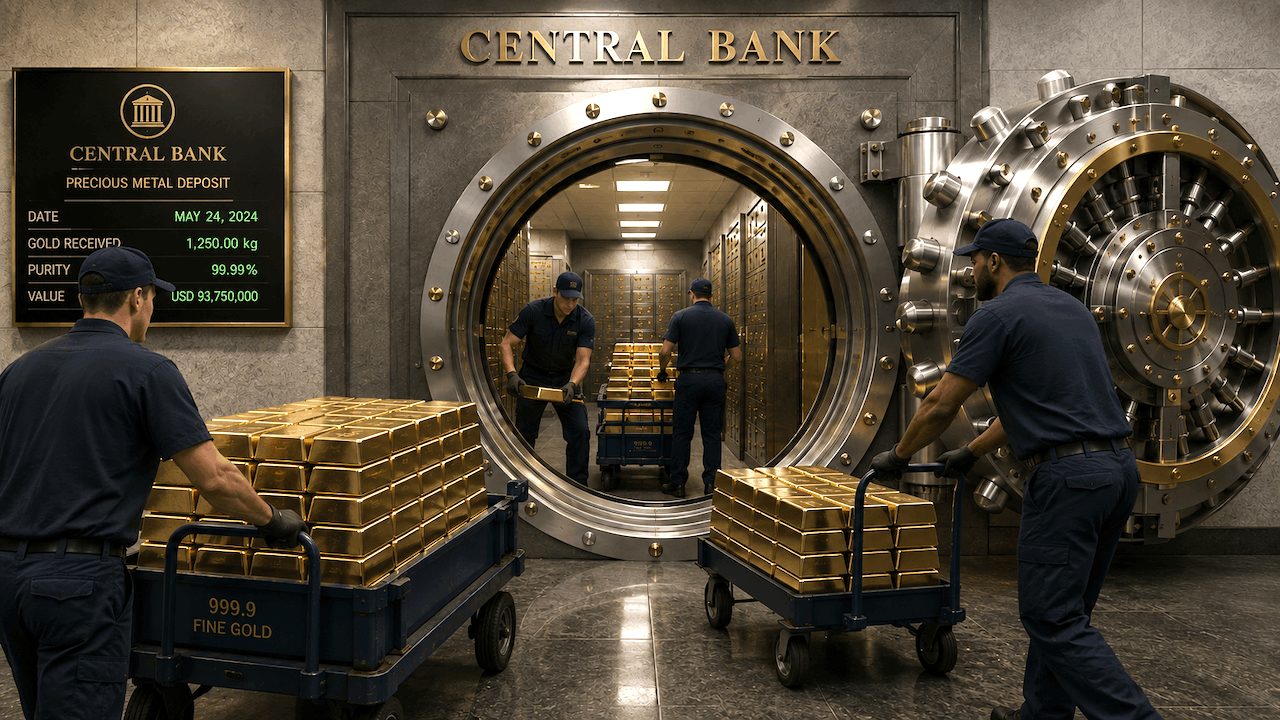
Maharrey cited financial journalist Jamie McGeever, who wrote in a Reuters op-ed that none of those pressures alone would necessarily explain gold’s revival. Together, McGeever argued, they form “a pretty compelling checklist,” particularly for central banks that had already resumed heavier buying after a weaker first quarter.
Buying Rebounded After a Slow First Quarter
According to the source, central-bank purchases slowed in the first quarter under price pressure, then strengthened in April. Maharrey reported that central banks bought 289 tonnes of gold in the second quarter, nearly five times the first-quarter total.
That renewed demand matters because central banks are not short-term traders. Their reserve decisions can signal longer-running concerns about currencies, sovereign debt and global financial plumbing.
Geopolitical Risk Keeps Gold in the Conversation
Maharrey wrote that conflict involving the U.S. and Iran has created an unstable backdrop for markets. He said gold initially received a safe-haven bid, then sold off and traded sideways as oil-price pressure and inflation concerns fed worries about higher interest rates.
McGeever described the environment as “an unnerving geopolitical and policy backdrop that has reminded the world of gold’s underlying appeal.”
In the source’s framing, the central issue is not one event but the persistence of instability. If investors and central banks see geopolitical risk as durable rather than temporary, gold’s role as a hedge becomes more attractive.
The Dollar’s Power Has Become a Liability for Some Countries
The second factor is the so-called weaponization of the dollar. Maharrey noted that after Russia invaded Ukraine, the U.S. and Western allies imposed sweeping sanctions that effectively restricted Russia’s access to the global financial system.
From a Western foreign-policy view, those sanctions may have been justified. But the source argues they also sent a message to other governments: reserves held in dollars can become a vulnerability if political relationships deteriorate.
That fear, Maharrey wrote, has accelerated efforts by some countries to reduce dependence on the greenback. He also stated that central banks have been reducing dollar exposure while increasing gold holdings.
The analysis cited the European Central Bank as having confirmed earlier this year that gold had surpassed Treasuries as the top reserve asset.
U.S. Debt Is Adding Pressure
Maharrey also pointed to U.S. fiscal strain. He wrote that the national debt is approaching $40 trillion and that federal spending continues to rise. He also cited a recent monthly budget deficit as the largest in five years.
The concern is that foreign buyers may become less willing to finance U.S. borrowing at the same scale. Maharrey wrote that Treasury yields have moved higher, with some analysts viewing the move as the start of a secular bear market in bonds.
McGeever noted that the benchmark 10-year Treasury yield had reached its highest level in 18 months, while 30-year bond yields and 30-year inflation-protected bond yields were at their highest levels since 2007 and 2008, respectively.
Economist Phil Suttle, quoted in the source, warned that the U.S. may be entering a new phase: “The U.S. is now in a phase where its global seigniorage benefits of supplying the world’s reserve currency have now been exhausted; the next phase (which may already be underway) is what happens when the foreign official holders of your liabilities become more antsy about holding them.”
Policy Uncertainty Is Another Gold Tailwind
The fourth factor is regime uncertainty. Maharrey argued that markets struggle when businesses and investors cannot anticipate policy, regulation or monetary direction.
He pointed to tariff uncertainty as one example, writing that companies cannot easily plan when they do not know what the tariff landscape will look like in the near future.
The source also raised concerns about Federal Reserve independence and market uncertainty over monetary policy. Maharrey cited McGeever’s view that reports of political pressure around the Fed had unsettled the bond market.
BNY analysts, quoted in the source, said official-sector demand and investor interest may continue supporting gold’s role as a hedge: “Gold is not a pure Fed signal, but persistent official-sector demand and renewed investor interest are reinforcing the value of inflation, currency and geopolitical hedges.”
McGeever’s conclusion was that the trend could support a longer-term gold bull market. “As confidence in the world’s reserve assets frays, gold’s allure is unlikely to dim,” he wrote.
For central banks, the case for gold appears to rest less on one dramatic catalyst than on a cluster of risks: war, sanctions, debt, inflation, policy uncertainty and doubts about the dollar-centered reserve system. If those risks persist, the official-sector appetite for gold may remain one of the market’s most important signals.